

Wisdom Teeth Removal in Conway
Having Your Wisdom Teeth Extracted
What Happens Before Your Wisdom Tooth Removal?
With an oral examination and x-rays of the mouth, Dr. Collins can evaluate the position of the wisdom teeth and predict if there are present or future potential problems. Studies have shown that early evaluation and treatment result in a superior outcome for the patient. Patients are generally first evaluated in the mid-teenage years by their dentist, orthodontist, or by an oral and maxillofacial surgeon.
All outpatient surgery is performed under appropriate anesthesia to maximize patient comfort. Dr. Collins is trained, licensed, and highly experienced in providing various types of anesthesia for patients. To provide you with the best surgical experience possible, Collins Oral & Facial Surgery employs a Certified Registered Nurse Anesthetist (CRNA) to administer IV sedation and general anesthesia in our office surgical setting, where you are continually monitored during and after surgery. Our surgical staff members are experienced, certified oral and maxillofacial surgical assistants, who are certified to assist in the administration of IV sedation and surgery. All surgical staff members are certified in Basic and Advanced Cardiac Life Support.
Are you or your loved one suffering from wisdom tooth pain?
Call our Conway AR office (501) 336-8888 to schedule an appointment with Dr. Collins or
Why should I have my wisdom teeth removed?
If you do not have enough room in your mouth for your third molars to fully erupt, a number of problems can happen.
Impacted wisdom teeth should be removed before their root structure is fully developed. In some patients, it is as early as 12 or 13, and in others, it may not be until the early twenties. Problems tend to occur with increasing frequency after the age of 30. Some of the possible problems related to not removing your wisdom teeth include:
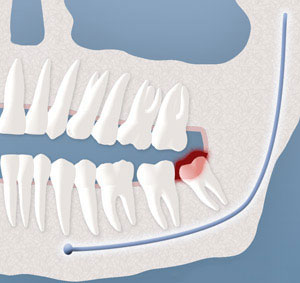
Infection:
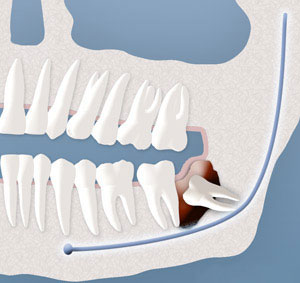
The most frequent clinical problem we see is pericoronitis, (a localized gum infection). Without enough room for total eruption, the gum tissue around the wisdom tooth can become irritated and infected, resulting in recurrent pain, swelling, and problems with chewing and/or swallowing.
Cyst Formation:
Non-infectious diseases may also arise in association with an impacted wisdom tooth. Cysts are fluid-filled “balloons” inside the jaw bone that develop as a result of impacted teeth and slowly expand destroying adjacent jaw bone and occasionally teeth. They can be very difficult to treat if your wisdom teeth are not removed in your teenage years. Although rare, tumors can be associated with the delayed removal of wisdom teeth.
Possible Crowding:
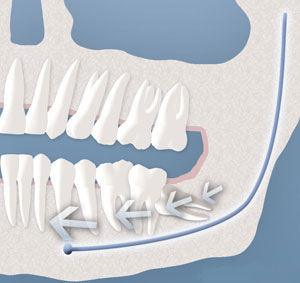
Impacted wisdom teeth may contribute to the crowding of your teeth. This is most noticeable with the front teeth, primarily the lower front teeth, and is most commonly seen after a patient has had braces. There are a number of factors that cause teeth to crowd after braces or in early adulthood. Retained, impacted wisdom teeth may be a contributing factor. Unless you have an active problem when you see the oral surgeon, the reason for removal is primarily to prevent long-term damage to your teeth, gums, and jaw bone.
Damage to Adjacent Teeth:
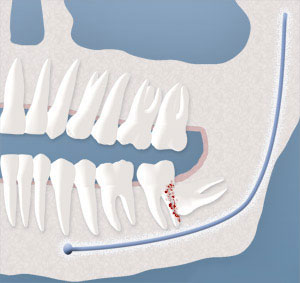
If there is inadequate room to clean around the wisdom tooth, the tooth directly in front, the second molar, can be adversely affected resulting in gum disease, bone loss around the tooth, and/or decay.
What is an impacted tooth?
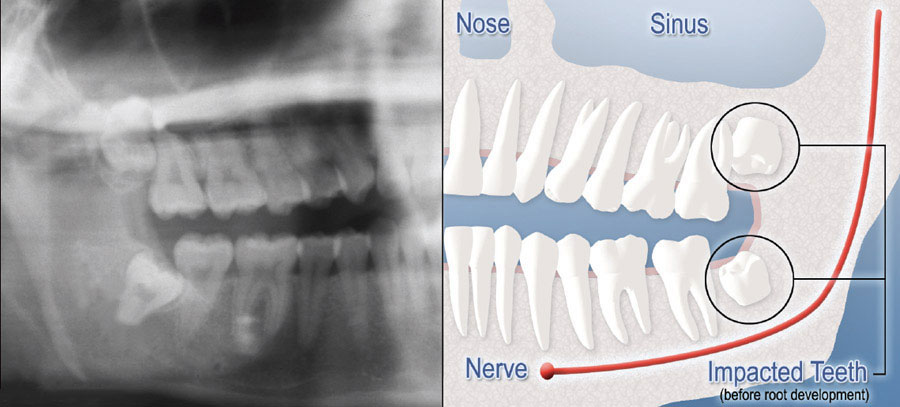
Although most people develop and grow 32 permanent adult teeth, many times their jaws are too small to accommodate the four wisdom teeth. When inadequate space prevents the teeth from erupting they are called impacted wisdom teeth. This indicates their inability to erupt into the proper position for chewing and cleaning.
Are you or your loved one suffering from wisdom tooth pain?
Call our Conway AR office (501) 336-8888 to schedule an appointment with Dr. Collins or
What are the types of Wisdom Teeth Impaction?
We will need to see you for a consultation to determine if you will benefit from wisdom tooth removal. A special x-ray of your mouth and jaws (panorex) will be taken to determine if your wisdom teeth are impacted if there is room for them to erupt, and how difficult it will be to have them removed.
- Soft Tissue Impaction: There is not enough room to allow the gum tissue to retract for adequate cleaning of the tooth.
- Partial Bony Impaction: There is enough space to allow the wisdom tooth to partially erupt. However, the tooth cannot function properly in the chewing process and creates cleaning problems, among others.
- Complete Bony Impaction: There is NO space for the tooth to erupt. It remains embedded in the jaw bone or if even partially visible requires complex surgical techniques for removal. The impacted wisdom tooth may also be in an unusual position and difficult to remove. This situation can also arise when the shape or size of the jaw bone and other facial structures make the removal of this tooth significantly more complex.
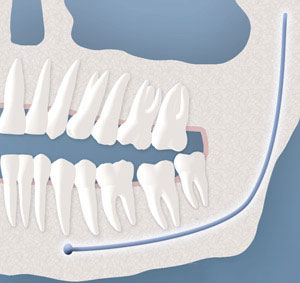 Soft Tissue
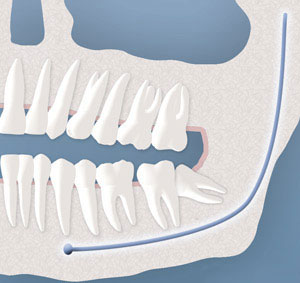 Partial Bony
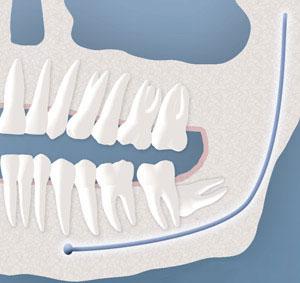 Complete Bony
What if I don’t have my wisdom teeth removed as a teenager or young adult?
As wisdom teeth develop, the roots become longer and the jaw bone denser. When it is necessary to remove impacted wisdom teeth in your thirties, forties, or beyond, the post-operative course can be prolonged and there is a higher complication rate.
Treating these complications is often more difficult and less predictable than with a younger patient. Healing may be slower and the chance of infection can be increased.
If your impacted wisdom teeth are not removed in your teenage years or early in your twenties and they are completely impacted in bone, it may be advisable to wait until a localized problem (such as cyst formation or localized gum disease and bone loss) develops. In general, you will heal faster, more predictably, and have fewer complications if treated in your teens or early twenties.
Wisdom Teeth Removal Procedure
Most people prefer to be unaware of the experience when they have their wisdom teeth removed and usually decide to be sedated. You will be provided with appropriate anesthesia options at your consultation.
All outpatient surgery is performed under appropriate anesthesia to maximize your comfort. Our office staff has the training, licensing, and experience to provide the various types of anesthesia. These services are provided in an environment of optimum safety, utilizing modern monitoring equipment, and well-trained experienced staff.
On the day of your procedure, you will take medications to help minimize post-operative pain and swelling. We ask that a parent or responsible adult accompanies you to the office and plans to stay with you for the rest of the day.
The procedure will take about 30 to 60 minutes and you will probably be in the office for 90 minutes. Recent advances in medicine and technology allow patients to undergo wisdom tooth removal in a manner, which promotes rapid healing and minimal post-operative discomfort. State-of-the-art sterilization and infection control techniques are used at all times.
In the morning or afternoon of your surgery, it is essential that you have nothing to eat or drink (excluding prescription medications with a sip of water) for at least 6 hours (preferably longer).
This does not mean you should try to fit in one “last meal” exactly six hours before your surgery.
Having anything in your stomach can increase the risk of serious anesthetic complications, including nausea and vomiting. Your procedure will be rescheduled if you have not heeded these guidelines.
We may provide you with a prescription for pain medication at your consultation appointment, which for your convenience, can be filled in advance. When you are seated in the surgical room, we will make every effort to make you as comfortable as possible. If you are going to be sedated, we usually will place an IV in your right arm.
This is a quick and nearly painless procedure that ensures optimal delivery of your medication. Local anesthesia is given to you afterward to ensure comfort, and allow adequate time to travel home and rest. You will be sleepy for a significant portion of the day.

The Day of Treatment
Be sure to have an adult with you at the time of removal. Make plans to have a parent or responsible adult stay with you for the rest of the day, following wisdom tooth removal.
If your surgery requires stitches, these are usually the type that dissolves in 3 to 5 days and do not require removal. You may also notice a sensation of your gums feeling swollen and pulling away from your teeth. This is all part of the normal recovery and will subside in several days.
Once the local anesthesia wears off, you may require prescription pain medication. The local anesthesia may last until the following day, and should not be confused with an injury to your nerve. We recommend starting your post-operative diet with clear liquids such as jello and broths, gradually increasing in substance as your body permits.
What does wisdom tooth removal cost and is it covered by insurance?
The fee for your treatment is determined by a number of factors.
These may include the difficulty involved in removing your teeth and which type of anesthesia is best for you. During your consultation appointment, the surgeon will need to review your x-rays, complete an examination and determine the best option for anesthesia, before an accurate estimate can be provided. Every insurance company has a different policy regarding the extent of coverage for a given surgical procedure. The oral surgeon’s office staff will help you obtain maximum insurance coverage for your treatment.
Factors That Affect the Cost of Your Wisdom Tooth Removal Procedure
Complexity of the Procedure
- Impacted Teeth: Teeth that are fully or partially impacted (trapped under the gum or bone) are more difficult to extract, increasing the cost.
- Tooth Position: Horizontally or awkwardly positioned teeth may require more complex surgical techniques.
2. Number of Teeth Being Removed
- The cost increases with the number of wisdom teeth extracted. Removing all four at once typically costs more than extracting one tooth but may save on overall fees for anesthesia and other services.
3. Type of Anesthesia Used
- Local Anesthesia: Generally included in the base cost of the procedure.
- Sedation Options: Nitrous oxide (laughing gas), IV sedation, or general anesthesia can significantly increase the cost.
4. Geographic Location
- Prices vary depending on the region and the cost of living. Urban areas with higher costs of living often have higher dental fees compared to rural areas.
5. Experience and Qualifications of the Surgeon
- Oral surgeons typically charge more than general dentists due to their specialized training. A highly experienced surgeon may also charge higher fees.
6. Pre-Operative and Post-Operative Care
- Diagnostic Imaging: X-rays or CBCT scans to assess the position of the teeth and nerves can add to the total cost.
- Follow-Up Visits: Some practices include follow-ups in the total fee, while others may charge separately.
7. Additional Medical Considerations
- Infections or Complications: If there’s an infection or other complications (e.g., cysts), additional procedures or medications may increase the cost.
- Health Conditions: Patients with underlying medical issues may require extra care or consultation, increasing costs.
What if I have questions before surgery?
At the time of your consultation, your specific situation will be discussed in greater detail. We encourage you to ask any questions you may have. If new questions arise after your consultation, please call our office at Conway Office Phone Number (501) 336-8888 to speak to one of our patient care coordinators.
To read more about wisdom teeth view our informative pages below.

The Day of Treatment
Please do not eat or drink anything prior to your surgery. Having anything in your stomach can increase the risk for serious anesthetic complications.
Collins Oral & Facial Surgery
Patient Review
Great staff and great experience
- Blaklee S